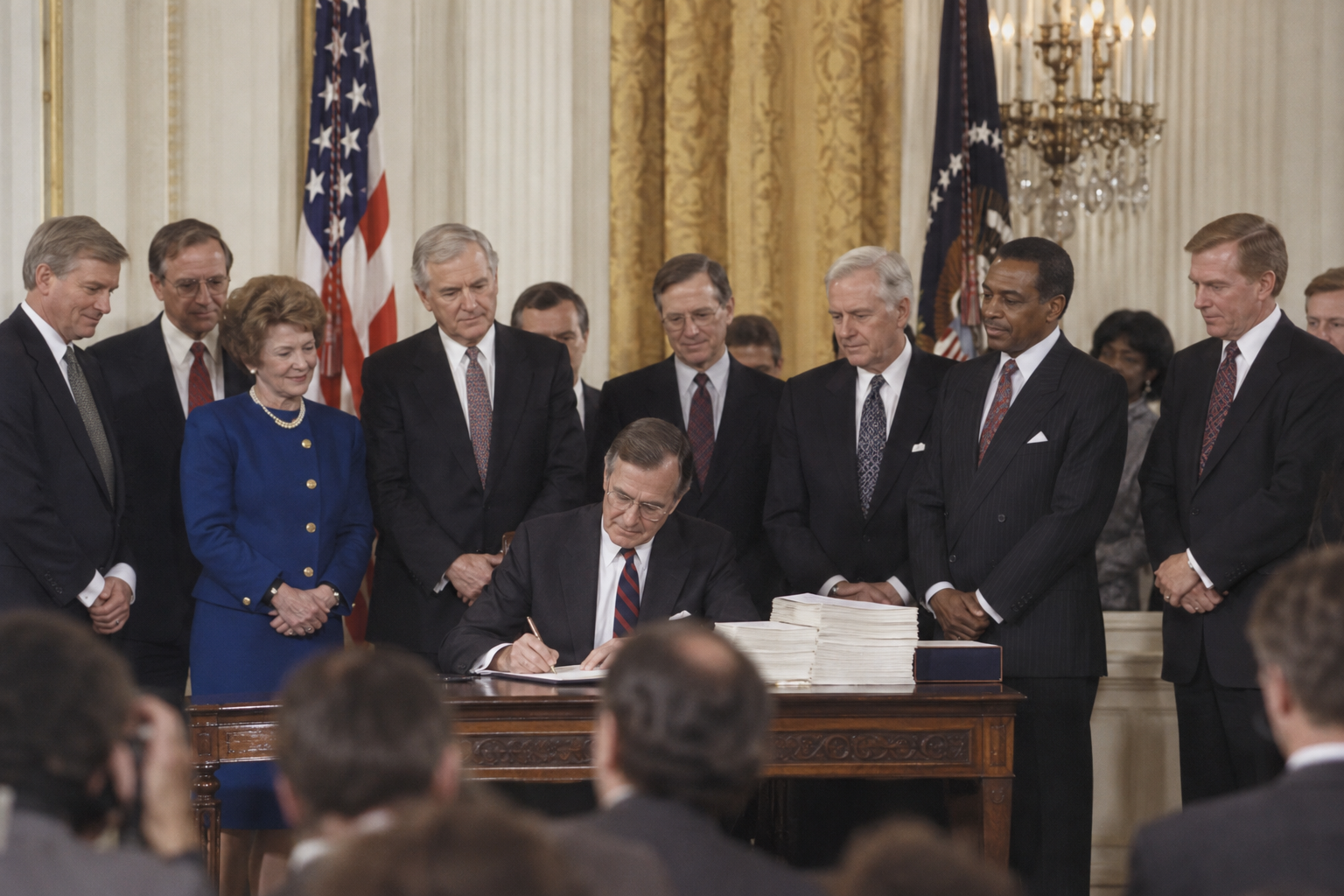
The 1990 Immigration Act Never Asked the Citizenship Question
Roughly 25 million immigrants have naturalized since the 1990 Immigration Act tripled admissions. The law set the numbers and left the naturalization standard at a 100-word vocabulary list.

Key Findings
The 1990 Immigration Act raised the annual cap on legal admissions from 270,000 to 675,000 and created the H-1B visa and the Diversity lottery. It left the naturalization standard untouched: five years of residence and a reading and writing test built on a list of roughly 100 words.
Roughly 25 million people have naturalized since 1990. By 2020 the Pew Research Center counted 23.2 million naturalized citizens eligible to vote, one in ten of the electorate and the highest share on record.
Mayda, Peri, and Steingress find the political effect of immigration runs through naturalization, and is strongest among the high-skilled arrivals the H-1B program selects for.
The reform follows from the diagnosis: cut admissions to 500,000 or fewer, extend the naturalization residency requirement from five years to ten, require functional English, and resolve the DACA cohort by statute rather than by memorandum.
Every immigration system answers two questions. The first is how many people to admit. The second is what full membership requires of them. The Immigration Act of 1990 answered the first question generously, raising the annual cap on legal admissions from 270,000 to 675,000, creating the H-1B visa, and launching the Diversity Visa lottery. It barely addressed the second. The naturalization standard it left in place dates to a different era and a far smaller system: five years of residence, a civics quiz drawn from a published list of 100 questions, and a reading and writing test built on a vocabulary list of roughly 100 words.[1]
The volume that flowed through that standard is the story. The United States has added roughly 32 million foreign-born residents since 1990 and naturalized approximately 25 million people over the same period, with annual naturalizations running between 750,000 and one million for most of the past 15 years.[2] By 2020, the Pew Research Center counted 23.2 million naturalized citizens eligible to vote, one in ten eligible voters and the highest share on record.[3]
A change of that scale in the composition of the citizenry is structural, and it deserves to be examined as policy rather than treated as a byproduct. Congress debated the 1990 Act as a labor and visa bill. The floor fights were about employment categories and per-country ceilings. Nobody framed the legislation as a decision about what the American electorate would look like in 2026, and no Congress since has revisited the naturalization standard to match the scale the 1990 Act created.
What the Research Found
Economists have measured what large-scale immigration does to local political composition. Anna Maria Mayda of Georgetown, Giovanni Peri of UC Davis, and Walter Steingress of the Bank of Canada published "The Political Impact of Immigration: Evidence from the United States" in the American Economic Journal: Applied Economics, examining county-level data from 1990 onward.[4] Their central finding is that the political effect of immigration runs through citizenship. Where arriving immigrants naturalize at high rates, vote shares move toward the Democratic Party. Where the foreign-born population remains largely non-citizen, the presence of that population moves existing voters in the opposite direction. The skill mix matters as well: the naturalization effect is strongest among high-skilled arrivals, the cohort the H-1B program selected for.
The finding is descriptive, not partisan. It establishes that admission levels and naturalization rates are not politically neutral administrative numbers. A statute that triples admissions is also, over a 35-year horizon, a statute that reshapes the electorate that will judge every future statute. That is a decision a self-governing country should make deliberately, with the trade-offs on the table, rather than inherit from a visa-category compromise negotiated in 1990.
A Standard Built for a Smaller System
The current naturalization requirements were calibrated for the low-volume decades. An applicant must hold a green card for five years, three if married to a citizen. The English requirement, on the books since 1906, is administered at a basic conversational level: the officer dictates one sentence from a published list for the writing test and asks the applicant to read one aloud. The civics test requires six correct answers out of ten questions, drawn from the public list of 100.[1]
Other developed countries set the bar higher. Switzerland requires ten years of residence and demonstrated language competence assessed at the cantonal level. Italy, Spain, and Austria require ten years for ordinary naturalization. Denmark requires applicants to pass a dedicated national language examination well above conversational level, along with a citizenship test and a self-support requirement. These countries treat naturalization as the certificate that integration is complete, not as a milestone that arrives automatically with the passage of time.
The American five-year window, combined with a vocabulary-list language test, certifies very little. English proficiency is the strongest single predictor of immigrant earnings growth and civic participation, and a naturalization standard that does not require it forfeits the one point of leverage where the country can ask something of its newest members. An immigrant who reaches citizenship with functional English, real civics knowledge, and a decade of rootedness is an asset to any community. The current standard does not produce that outcome; it processes paperwork.
Deferred Action and Who Decides
The same pattern of consequential decisions made outside the statute books runs through the deferred-action programs. The Deferred Action for Childhood Arrivals program was created in June 2012 by a Department of Homeland Security memorandum, not by legislation. Congress had considered versions of the DREAM Act since 2001 and declined to pass them; the December 2010 Senate vote fell five votes short of cloture. The 2012 memo granted work authorization and protection from removal to roughly 800,000 people Congress had specifically considered and declined to cover.[5]
The legal system has spent the years since sorting out the consequences. The Fifth Circuit Court of Appeals held the program unlawful, and litigation over its survival has run for nearly a decade while recipients remain in limbo. Whatever position one takes on the underlying cohort, the institutional lesson is the same one the naturalization numbers teach: decisions that change who holds status in the United States, and who eventually reaches citizenship, belong to Congress. A status category with a plausible path toward permanent residence should not exist unless a majority of both chambers voted to create it.
The 2026 Reform Agenda
Three provisions follow from this record, and each sits squarely within Congress's authority over naturalization under Article I.
The first is volume. Annual legal admissions of roughly 1.1 million exceed the country's demonstrated capacity to integrate arrivals, a capacity visible in the historical record. The 1924 Act cut admissions by approximately 80 percent, the foreign-born share fell from 13 percent to 4.7 percent by 1970, and the immigrant wave of 1890 to 1924 assimilated completely into American life.[6] Cutting admissions to 500,000 or fewer, concentrated in the family-preference and lottery categories, would restore the ratio of newcomers to established citizens under which integration has historically succeeded.
The second is the naturalization standard itself. Extend the residency requirement from five years to ten, matching Switzerland, Italy, Spain, and Austria. Replace the vocabulary-list English test with a standardized assessment of functional written and spoken proficiency. Rebuild the civics test around genuine comprehension of American government rather than memorization of a published answer key. Citizenship should certify that integration has happened.
The third is statutory clarity on deferred action. Congress should codify that executive deferred-action programs create no eligibility for permanent residence, and it should resolve the existing DACA cohort by an actual vote, in whichever direction the votes exist. Thirteen years of governance by memorandum and injunction is a failure of legislative responsibility, not a policy.
The 1990 Act set the admission numbers and never revisited what citizenship requires. A serious reform in 2026 would answer both questions in the same statute.
Sources
- U.S. Citizenship and Immigration Services, Study for the Naturalization Test - Official naturalization test materials, including the English and civics requirements
- U.S. Citizenship and Immigration Services, Naturalization Statistics - Annual naturalization counts since 1990
- Pew Research Center, "Naturalized Citizens Make Up Record One-in-Ten U.S. Eligible Voters in 2020," February 2020 - 23.2 million naturalized eligible voters
- Anna Maria Mayda, Giovanni Peri, and Walter Steingress, "The Political Impact of Immigration: Evidence from the United States," American Economic Journal: Applied Economics - County-level analysis of immigration and political composition
- Congressional Research Service, Deferred Action for Childhood Arrivals (DACA): By the Numbers and Legal Developments - DACA program scope and legal history
- Migration Policy Institute, "A Century Later, the 1924 U.S. Immigration Law's Far-Reaching Impact" - Foreign-born share decline after the 1924 Act